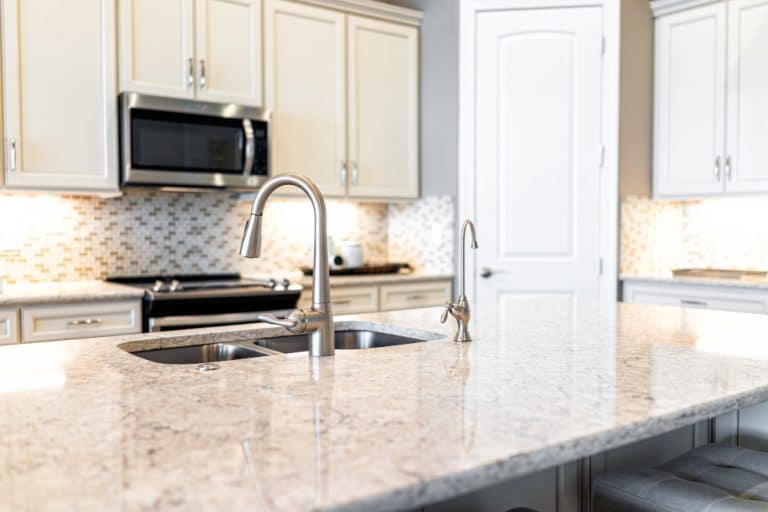
Summary: Paint and stone coat epoxy are offered as an alternative to genuine granite if you love the look of real stone but can’t afford it. Mimicking granite with paint and stone coat epoxy is definitely cheaper, but there are tradeoffs.
No doubt kitchen renovations can be costly. When you are working with a limited budget and you really want new countertops and brand-new appliances, having to make concessions is normal. The biggest challenge is deciding where to save money and where to spend it. For example, should you invest in genuine granite or look at a substitute?
In recent years, we have seen a rise in DIY videos showing homeowners how to mimic the look of genuine granite using paint and stone coat epoxy. The idea is to use wood, paint, and an epoxy material to mimic the look of granite without actually using natural stone. Obviously, the savings are significant. But underneath the aesthetic layers of paint and epoxy, you still have wood.
Does that matter? That’s up to you as a homeowner. Here at Bedrock Quartz, we are cognizant of the fact that the budget does not always support genuine stone countertops. But we want consumers to know what they are getting for their money should they decide to invest in real granite.
Countertop Material Choices
Most people see the countertop as the visual centerpiece of the kitchen. That is normal, given how prominent countertops are. The right look can be the crowning achievement of a recent kitchen renovation. Aesthetics are important, especially for resale, but a countertop needs to do more than look good. It also needs to be a functional and durable workspace.
Countertops endure daily wear and tear from utensils, pots and pans, dishes, and so forth. They also need to stand up against spills and cleaning chemicals. This is why countertop material matters. Whatever material a homeowner chooses, there are always legitimate concerns about:
- Durability – How well will the surface resist scratches, stains, heat, and impact?
- Maintenance – How easy is the surface to keep clean? What types of cleaning products can be used on it?
- Long-Term Protection – Does the service need to be resealed? If so, how often?
Choosing the best material is a matter of balancing these factors with a family’s needs. For example, an older couple that doesn’t do much cooking at home does not have to worry as much about maintenance and sealing. But a younger family with several kids and regular meals cooked daily needs to be more concerned about it.
What You Get With Genuine Granite
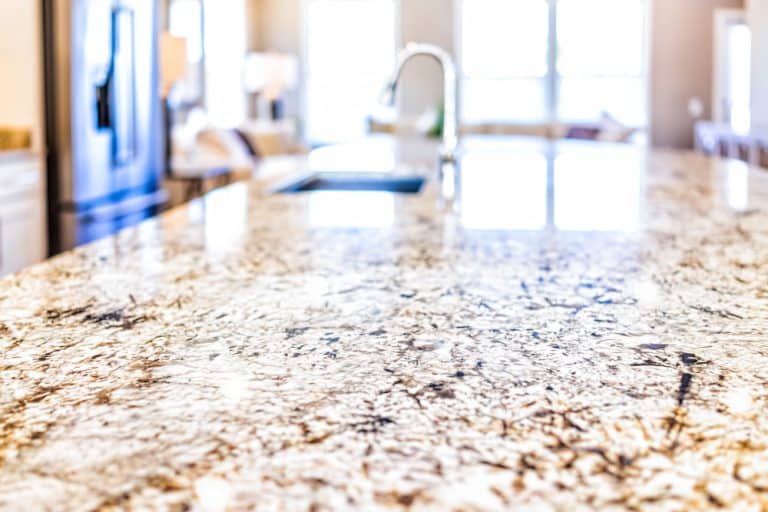
Granite is a natural stone and an ideal material for kitchen and bathroom countertops. On the Mohs scale – a scale that measures hardness – granite typically comes in at 6-7. This means it is highly resistant to scratches. It can also withstand direct contact with hot materials without serious damage, although we still recommend using trivets and potholders to protect the finish.
The big downside to granite is that it is naturally porous. So to prevent stains and etching, granite needs to be sealed regularly. Every year or two is appropriate for extremely busy kitchens that see a lot of wear and tear. A resealing schedule closer to five years is possible in kitchens that do not get heavy use.
In terms of lifespan, you can expect a real granite countertop to last 20-30 years with proper care. And in lightly used kitchens, exceeding 30 years is possible. The reality is that you get a lot of service out of granite just by taking good care of it.
The Paint in Stone Coat Epoxy Substitute
If you really like the look of granite but simply cannot afford it, it is possible to mimic the look had a fraction of the cost. You do this with a combination of paint and stone coat epoxy. Generally, you’re working with a wood surface that can be anything from high-grade particleboard just something like pine or maple.
You begin by priming the surface and edges. Then you apply a base coat – a lot of people start with a light brown. You follow with multiple layers of paint that are the same color but different shades, applied with a sponge roller. You keep building layer on layer until you are satisfied with the look.
You then seal with a layer of stone coat epoxy and a topcoat to finish things off. You wind up with a glossy finish over multiple layers of paint that mimic the look of ornate granite.
There is no need to pick out all the paints and epoxy on your own. You can purchase complete kits with everything you need. They are very affordable and found at nearly every DIY home improvement store.
How It Compares
From an aesthetic standpoint, paint and stone coat epoxy can look surprisingly similar to genuine granite. Getting it right takes practice, of course. Finishing with epoxy and a topcoat results in a smooth, high-gloss surface that can look pretty spectacular under the right light. However, that is where the similarities end.
Genuine granite is extremely hard. Epoxy is not. The epoxy layer will be susceptible to scratches and chips. Furthermore, while it can tolerate moderate heat, sudden temperature changes can cause the epoxy to crack.
Over time, the different layers of paint will begin to fade. You will notice uneven color in areas exposed to direct sunlight as opposed to those that are not. You shouldn’t have any problem with water as long as the epoxy and topcoat are applied evenly. But if there are any thin areas, especially near seams, long-term water damage is a possibility.
A Good Substitute, But Not a Great One
Paint and stone coat epoxy is a good substitute for genuine granite if your budget simply can’t support actual stone. But it’s not a great one. There are tradeoffs, not the least of which is durability.
If you are looking to remodel your kitchen and your heart isn’t set on granite, consider quartz. As a manufactured product, it is extremely durable and less expensive than genuine stone. Quartz can be manufactured to closely mimic granite as well. You will still wind up with a more durable countertop compared to paint and stone coat epoxy.
FAQs
What makes granite countertops so expensive?
The expense of granite countertops is wrapped up in multiple things, including quarrying, transportation, handling, and fabricating. All are labor intense.
If I installed granite, would it be the last installation in my current home?
Given that genuine granite can last 20-30 years, it usually outlasts the homeowners who install it. Most sell and move on long before the countertops need replacing.
How long does a paint and stone coat epoxy countertop last?
There is no way to say for sure how long paint and stone coat epoxy will last. It needs to be re-coated every few years. Provided it’s taken care of, it could last quite a while.
Is epoxy as hard as granite?
No, epoxy is softer and more flexible than genuine stone. That makes it less brittle, but also less strong. Epoxy over the top of a wood surface will not be nearly as strong as genuine stone.