Summary: It’s not unusual for consumers to mistakenly believe quartz countertops usually require less reinforcement than marble or granite. This misunderstanding is because of the assumption that quartz is lighter. It’s not. But weight isn’t the actual issue when it comes to reinforcement work.
In modern kitchen or bathroom renovations, the highlight of the design process is often choosing the surface material for countertops. We have worked with a number of Sandy residents to create perfect spaces that are both welcoming and functional. From the city’s historic homes to more expansive properties in the Wasatch foothills, we have discovered that local homeowners want a countertop surface that balances beauty with structural integrity. Stone immediately comes to mind. But so does quartz.
We have noticed a trend among consumers in recent years: a trend that has them questioning stone versus quartz based on weight. Many Sandy showroom conversations have revolved around whether extensive and costly reinforcement work will be required to install stone materials like marble or granite.
The concern is legitimate. Reinforcement work is extra work that adds to project costs and extends remodeling timelines. Some consumers would gladly choose quartz over stone if that meant bypassing reinforcement work. But the reality of the situation is far more complex than a simple weight question.
Quartz Isn’t Substantially Lighter
Quartz allegedly being lighter than granite or marble is perhaps one of the biggest consumer misconceptions in our industry. Here’s the reality: while it is true that natural stone surfaces are typically dense and heavy, engineered quartz isn’t substantially lighter. In fact, quartz weighs about the same as granite foot-for-foot. In some cases, engineered quartz can actually be heavier and denser.
Quartz countertops are made by combining approximately 90% crushed quartz minerals with polymer resins and pigments. The manufacturing process compresses the material into a solid slab. Air pockets are eliminated while the polymer resin holds everything together. The result is a very dense material that tends to have a similar weight profile compared to natural stone.
All of this is to say that choosing quartz over marble, granite, or quartzite will not necessarily prevent the need to reinforce cabinetry or flooring. The need for reinforcement work is more about the cabinets and floors themselves. So if you fall in love with a granite or marble slab, don’t settle for quartz based solely on the fear that natural stone is too heavy for your Sandy remodeling project.
The Actual Weight Might Astound You
A little perspective is in order here. A standard 2-3-centimeter-thick slab of granite, marble, or quartz should weigh 15-24 pounds per square foot. That means a new countertop boasting fifty square feet of space will weigh 750-1200 pounds. That is about the weight of a large touring motorcycle. It’s all weight that sits on top of your cabinetry.
However, don’t let that scare you. High-quality, professionally built kitchen cabinets are engineered to support extremely heavy loads. Brand-new cabinets should not struggle at all with either stone or quartz. As for existing cabinets, there’s probably nothing to worry about if they are made with solid wood or high-density, furniture-grade plywood.
Older cabinets are another matter. If they show signs of damage – particularly water damage around the sink – reinforcement work may be necessary. You’ll definitely need reinforcements if your cabinetry was made using cheap, thin particleboard.
Why the Rumor Persists
With your newfound knowledge about quartz and its weight and density, you might be wondering why the myth of quartz not needing reinforcement persists. The answer lies in the flexibility of the materials.
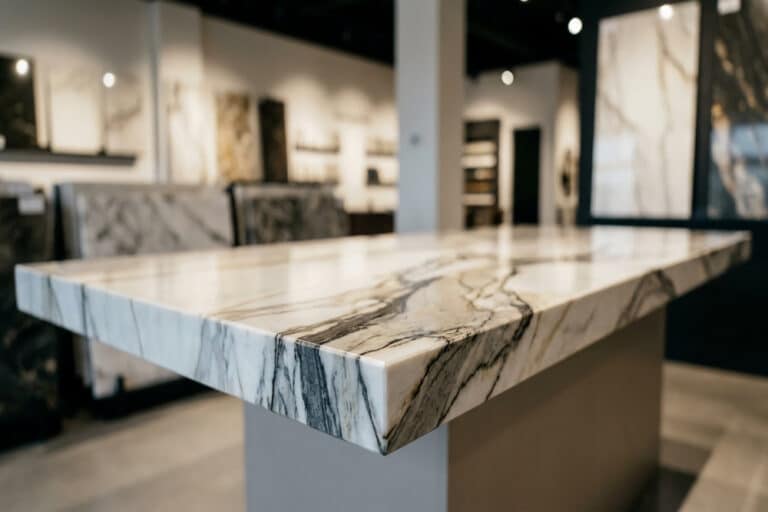
Natural stone is obviously a product of nature. As a result, materials like granite and marble are subject to inherent geological variations, directional veining, and microscopic fractures. These things combined give natural stone its aesthetic characteristics. Unfortunately, they also make natural stone more brittle.
Reinforcements are necessary to prevent sagging. Otherwise, sagging could snap a natural stone surface in half. In other words, reinforcement work is designed to protect the countertop surface rather than the cabinets or floor.
Engineered quartz is considerably more flexible. It gains its flexibility from the polymer resins that bind quartz minerals together. Think of the resins as a type of plastic. It is rigid enough to hold the countertop together, but flexible enough to bend and give. It doesn’t need nearly the same amount of structural support to prevent breakage.
How Stone Countertops Are Supported
Most stone countertop projects in the Sandy area need either little or no reinforcement work. When such work is required, it tends to be quite minimal and surprisingly noninvasive. Rare is the project that requires tearing up the floors and rebuilding the kitchen from scratch.
Reinforcements typically involve just a few minor adjustments:
- Leveling – Cabinetry that is even slightly off-level creates pressure points for natural stone countertops. But just leveling things out with high-strength shims fixes the problem. You get a perfectly flat, uniform plane with no pressure points.
- Internal Cleats – When installers are working with wide cabinet spans or weak spots, additional reinforcement is achieved through the installation of support cleats. These are wood support strips or metal brackets installed along the interior of the cabinet walls. The extra weight of the stone is evenly distributed across the entire cabinet with these cleats in place.
When contractors are working with thinner stone slabs, they may elect to install a layer of exterior-grade plywood before laying the countertop down. The extra plywood makes for a firmer foundation.
Islands and Overhangs
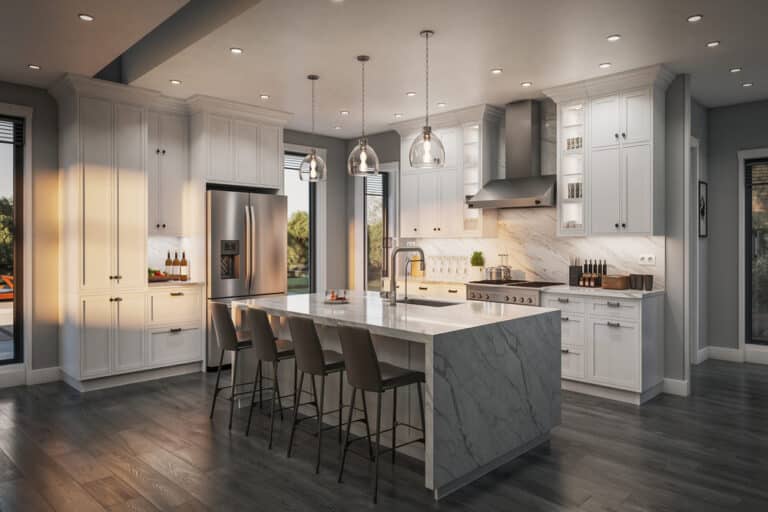
While the choice between stone and quartz makes little difference (in terms of weight) for countertops running along the wall, there is one scenario in which the choice the customer makes changes a lot: installing an island countertop.
Overhangs meant to accommodate bar stool seating generate physical tension on the unsupported section of slab. Therefore, an overhang should never exceed ten inches when installing marble or granite. Overhangs can extend up to fifteen inches when the surface material is quartz.
Here at Bedrock Quartz, stone and quartz countertops are our specialty. We invite you to visit our Sandy, Utah showroom where you can see all our slabs in person. Be sure to ask questions you have, especially those pertaining to weight concerns. And remember this: quartz is not substantially lighter than marble or granite.
FAQs
Isn’t natural stone heavier than engineered quartz?
Actually, no. Engineered quartz is just as dense as marble and granite. It weighs about the same as granite foot-for-foot.
If quartz weighs as much, why does it need less reinforcement?
Reinforcing countertops is about preventing cracks and clean breaks. Even though quartz is just as heavy, it is not as brittle. It needs less reinforcement because it is more flexible.
Does going with quartz eliminate the need for all reinforcements?
Not necessarily. Whether countertops need reinforcement depends on the condition of the underlying cabinetry and subfloor.
How can I know if my current cabinetry will support the weight?
Most modern cabinets built with solid wood or high-quality plywood can handle the weight of a stone or quartz countertop. Older cabinets, and ones made with cheaper materials, tend to need reinforcement. An installation contractor is the most qualified person to make that decision.