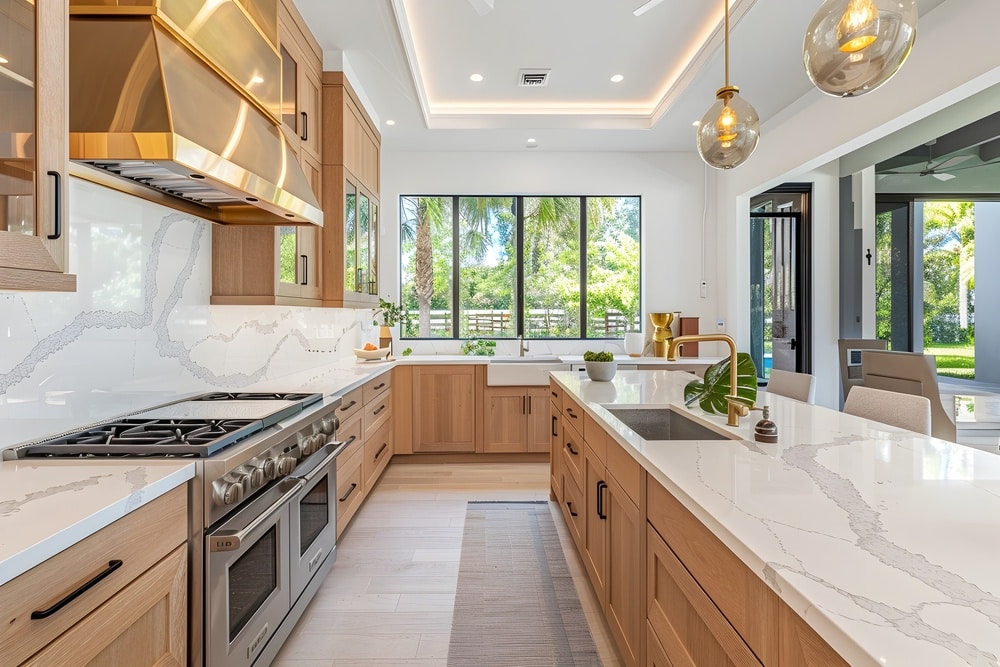
Summary: Engineered quartz is an excellent countertop choice material in Salt Lake County. Homeowners in Sandy and other communities are choosing it over granite and marble more often. But before you go with quartz, take some time to learn how it interacts with the local environment and climate.
Utah homeowners are increasingly choosing engineered quartz over natural granite and marble for their kitchen surfaces. Across the Wasatch Front, consumers point to the material’s non-porous durability, high-end aesthetic, and zero-maintenance appeal. But is there more to consider? Yes.
If you are planning to shop for quartz countertops in Sandy, we expect you to be interested in surface colors and veining patterns. But there are additional variables you need to pay attention to, variables that are directly related to the climate and natural environment.
Sandy’s Unique Geographic Position
Sandy, Utah, sits at an average elevation above 4,400 feet. It is at the base of the Little Cottonwood Canyon area, meaning it’s exposed to some specific environmental conditions that directly interact with the materials in local homes. This includes stone.
For example, south-facing windows subject kitchen countertops to excessive UV exposure during the summer. Those same countertops undergo thermal expansion shifts during the transitions between seasons. Our dry and cold winters create the most stress. So if you live in Sandy, your choice of countertop material will be easier with a deeper understanding of how stone performs around here.
Important Technical Factors
If you are interested in basic care tips and questions about installation, we have other posts that address those topics. For the purposes of understanding how the natural environment impacts quartz, this post will focus on two highly important technical factors: ambient climate stress and seam engineering.
1. The Wasatch Bench Effect
Homes in the Sandy area sit along what is referred to as one of the Wasatch ‘benches’. There are some key things about this particular area that we need to talk about. But before getting to them, it is important to understand exactly what engineered quartz is.
Quartz is a mineral found mainly in silica sand. The individual grains do not hold together well enough to create a countertop slab. So to manufacture engineered quartz, 90-93% natural quartz aggregate is combined with 7-10% polymer resin and inorganic pigments. The resin holds all the minerals together, while the pigments provide the color and veining.
It is important to note that the synthetic resin gives quartz its incredible stain resistance. But it also makes the material susceptible to certain environmental variables that are especially prominent in Salt Lake County.
UV Exposure
Did you know that the atmosphere filters out less UV radiation at higher elevations? Because Sandy is so highly elevated above sea level, UV exposure is a concern. The concern is exacerbated locally because we love homes featuring expansive floor-to-ceiling windows that give us such stunning views of the Wasatch Range.
High-intensity UV light streaming through non-tinted glass onto quartz countertops can trigger a chemical process known as photo-oxidation. Here are the potential effects:
- Resin Degradation – Some polyester resins slowly break down under prolonged UV exposure. This can cause bright white or cool gray surfaces to demonstrate slight yellowing over many years.
- Fading Pigments – Darker quartz tones can undergo localized surface fading because of long-term UV exposure. Years down the road, a countertop could look uneven in its shading.
What does all this mean? It means that evaluating quartz countertops in Sandy must account for lighting. If your kitchen gets plenty of heavy, direct sunlight, you are better off choosing an aliphatic resin formula or selecting a quartz slab with a lighter, warmer tone and UV-stable mineral pigments.
Thermal Shock
Another environmental variable to think about is thermal shock. In other words, how will your new countertop surface react to temperature swings?
Sandy winters are known for drastic temperature fluctuations. In addition to what is going on outside, anything from a drafty window to a poorly insulated exterior wall can reduce ambient air temperatures in the kitchen. Meanwhile, boiling a pot of water on the stove or heating up cookware introduces sudden heat.
Quartz easily handles ambient temperature changes. But it is susceptible to thermal shock, a form of localized stress caused by rapid thermal expansion. If the ambient temperature in the kitchen is rather cool, setting a hot cast-iron skillet directly on the countertop surface could actually crack or snap the slab.
Thermal shock isn’t a big risk if you’re careful to use things like trivets and hot pads. We also recommend installing strategic heat barriers around ovens and stoves just to be safe.
2. Seam Engineering
The other big hurdle when installing quartz countertops in Sandy is seam placement. Where seams land is always important, but even more so if you are choosing a design that features a dramatic veining pattern – like a slab meant to mimic Calacatta marble.
A small-grain, uniform granite will seamlessly blend at a 90° corner. Engineered quartz, not so much. Both book-matched and directional quartz require meticulous layout planning to avoid joining two slabs with mismatched directional sweeps. Getting it wrong could result in a transition that looks rather jarring.
Digital Mapping Technology
Fortunately, quartz countertops in Sandy don’t have to be left to chance. Modern digital mapping technology makes it possible to place seams perfectly. Before a single cut is made, installers utilize digital slab layout software featuring:
- High-resolution photo scanning that feeds data directly into a CAD application.
- Virtual layout overlays that superimpose the exact dimensions of your kitchen onto a digital image of the slab.
- Vein-matching capabilities that allow the fabricator to align the flow of every vein across the entire surface.
With digital mapping, we can figure out exactly where to make the cuts, where to place the seams, and how to fit everything together to create perfect transitions from one piece to the next.
Two-Part Epoxy Systems
We have a second trick up our sleeve: two-part epoxy systems. By utilizing specialized acrylic or epoxy adhesives that are custom-tinted to match the exact primary and secondary shades of your chosen slab, we can all but eliminate seam detection. Two-part epoxy systems help us create joints that are virtually unnoticeable, joints that also resist moisture and daily wear.
Before you begin shopping for quartz countertops in Sandy, do a little bit of homework on how Utah’s environment and climate impact natural and engineered stone materials. Better yet, visit our Sandy showroom and let our expert team members explain it all to you.
FAQs
How does high elevation impact quartz?
The biggest effect of elevation on quartz countertops is UV radiation. Higher altitudes mean more radiation, and more radiation means a higher risk of fading and discoloration for quartz countertops.
Are quartz countertops heat-resistant?
Quartz minerals are, but engineered quartz countertops are not. Always use trivets or hot pads to avoid thermal shock.
How is seam placement handled by installers?
Mastering seam placement begins in the fabrication stage. Digital mapping lays everything out before the first cut is ever made. At installation, installers use two-part epoxy systems to perfect joints.
Do quartz countertops require sealing?
Because quartz is a completely nonporous surface, it does not need sealing. It is one of the advantages of installing quartz countertops in Sandy.